SSP Day One + FWA Enforcement: What Hospitality and Retail Employers Must Have Ready Now
SSP Day One + FWA Enforcement: What Hospitality and Retail Employers Must Have Ready Now
Two major changes landed in April 2026 that both affect your sick pay records — and the Fair Work Agency is already checking them. Statutory Sick Pay (SSP) now starts from day one of absence (from 6 April 2026), and the Fair Work Agency launched on 7 April 2026 with immediate powers to inspect employer records. If you run a hospitality or retail business and haven't updated your sick pay process, you are exposed on two fronts simultaneously.
This guide explains exactly what changed, what FWA inspectors look for, and the steps you need to take now to stay compliant.
What Changed on 6 April 2026
Before 6 April 2026, employees had to be absent for three days before they became eligible for Statutory Sick Pay. Those first three days — known as "waiting days" — meant the employer paid nothing. That rule has been abolished.
From 6 April 2026, SSP applies from the very first day of absence. There are no waiting days. If an employee calls in sick on a Monday, you owe them SSP from Monday — not Thursday.
The current SSP rate is £116.75 per week, payable for up to 28 weeks. This applies to all employees earning at least the lower earnings limit (currently £123/week). Zero-hours workers, part-time staff, and casual workers all qualify if they meet the earnings threshold — which matters enormously in hospitality and retail where these contracts are the norm.
Additionally, from 6 April 2026:
- No self-certification limit for SSP purposes — you can ask for a fit note, but SSP liability starts day one regardless
- Written SSP policy required — if you don't have one, you're non-compliant from the start of an FWA inspection
- Record-keeping obligation tightened — you must record all absences, dates, SSP paid, and employee earnings
What the Fair Work Agency Is Checking Right Now
The Fair Work Agency replaced HMRC's National Minimum Wage enforcement function on 7 April 2026. But the FWA's remit goes significantly further. It has powers to inspect:
- National Minimum Wage and National Living Wage compliance
- Holiday pay records (12.07% rolled-up pay is the most common error)
- Statutory Sick Pay records
- Zero-hours contract compliance
- Right to work documentation
- Written terms of employment (day-one rights apply from April 2026)
Critically: the FWA bills employers for the cost of its investigations. Unlike HMRC, which absorbed enforcement costs, FWA inspections generate a bill. A standard investigation can cost the employer thousands of pounds in FWA fees — on top of any back-pay ordered.
The FWA's initial enforcement focus is hospitality, care, and retail — sectors with the highest historic NMW non-compliance rates. Inspections are already underway. The FWA does not always give advance notice.
Why Hospitality and Retail Are Highest Risk
If you run a café, restaurant, hotel, pub, or retail outlet, you face a set of structural compliance risks that make SSP + FWA enforcement particularly acute:
Zero-Hours and Variable-Hours Contracts
The majority of hospitality and retail workers are on zero-hours or part-time contracts. Many employers wrongly assume SSP doesn't apply to casual staff. It does. If a casual worker earns above the lower earnings limit (even averaged across the year), they qualify for SSP from day one. Failure to pay is an automatic FWA enforcement target.
High Absence Rates
Hospitality and retail have some of the highest absence rates in the UK economy. More absences mean more SSP liability — and more records to maintain. A business with 20 employees might process 50–80 SSP claims per year. Without a system, record-keeping fails fast.
NMW Violations Are Endemic
The FWA's predecessor (HMRC NMW enforcement) consistently found that hospitality was the most non-compliant sector. The most common breach was unpaid pre-shift time, uniform deductions, and tip offset errors. FWA inspectors know this — and they know where to look. An NMW investigation triggered by a tip-related complaint will typically also pull your SSP records.
Staff Turnover Destroys Record Continuity
High turnover — common in both sectors — means employers often have patchy records for former staff. Under FWA powers, inspectors can request records going back six years. If former employees made SSP claims that weren't properly documented, you carry that liability.
What Records You Must Have in Place
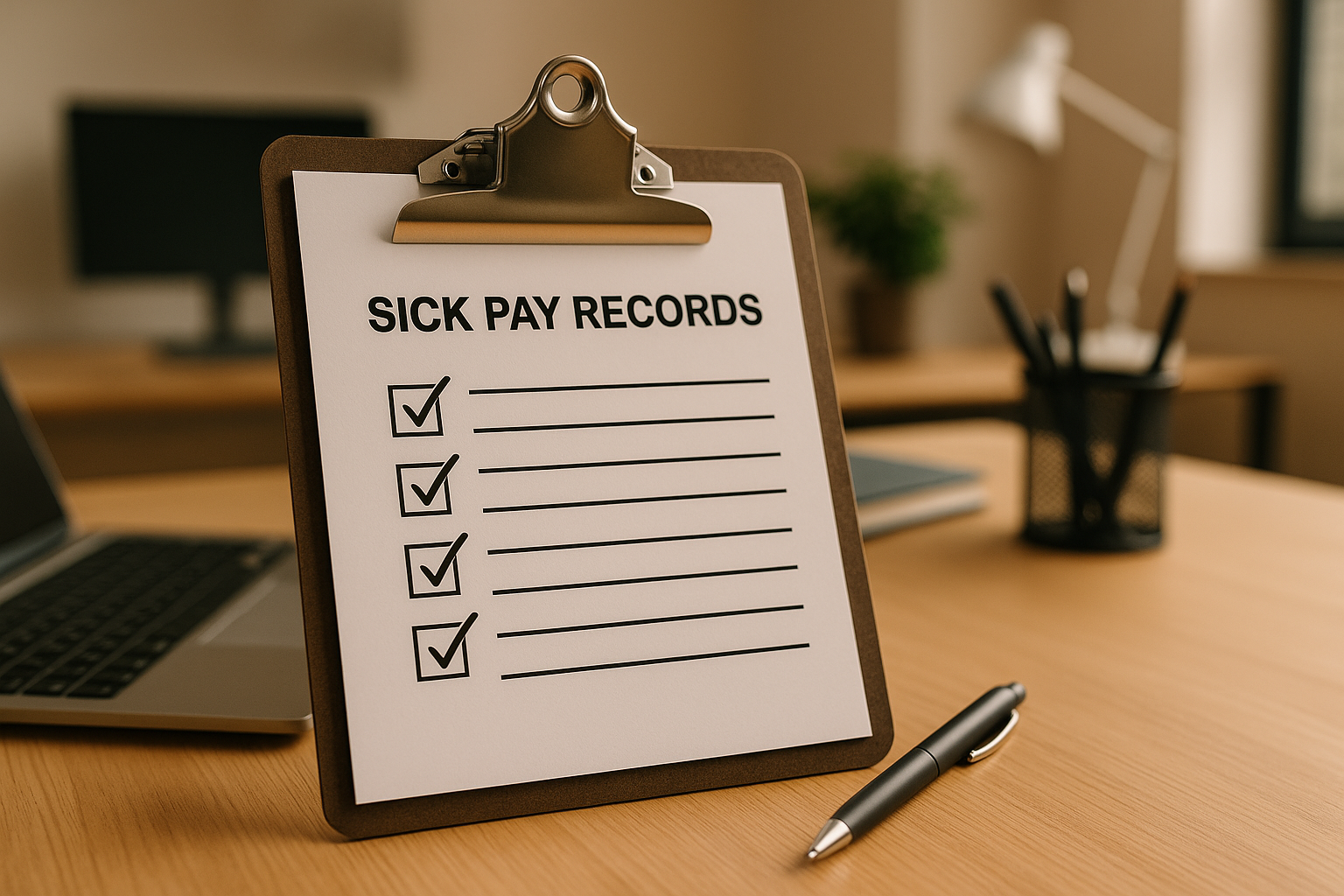
An FWA inspector will expect you to produce, on request:
Sick Pay Records
- Every absence recorded by date, including first day
- Whether SSP was paid, and at what rate
- The employee's average weekly earnings (used to determine eligibility)
- Any fit notes (sick notes) provided
- Records of SSP1 forms issued where SSP was withheld
Payroll Records
- Gross pay, hours worked, and deductions for every pay period
- Minimum wage calculations showing hourly rate (including tips, if relevant to your sector)
- Evidence that tipping deductions have not reduced pay below NMW (post-Tipping Act)
Employment Documentation
- Written statement of terms for every employee (required from day one since April 2020, but still a common gap)
- Right to work checks — valid passport or share code confirmation, stored securely
- Zero-hours contracts compliant with the October 2026 advance notice requirements (FWA will be checking these from Q4 2026)
Policy Documents
- Written SSP policy — how to report sickness, how SSP is calculated, how long it runs
- Absence management procedure
- If you operate tipping: written tipping policy and records of tip distribution
You don't need to have these in a specific format, but they must be retrievable within a reasonable timeframe. If you cannot produce records on FWA request, that absence of records is itself treated as evidence of non-compliance.
Five-Step Compliance Checklist for Hospitality and Retail
- Audit your payroll system for day-one SSP. Check that your payroll software has been updated to remove the three-day waiting rule. Any absence after 6 April 2026 should trigger SSP from day one if the employee qualifies. Check that zero-hours workers are included in the eligibility calculation.
- Create or update your written SSP policy. It doesn't need to be long — a single-page document explaining how employees report sickness, that SSP applies from day one, and how payment is processed. This must exist in writing. ComplianceAlert's document library includes a ready-to-use SSP policy template.
- Backfill any April absence records immediately. If you had staff absent between 6 and 17 April and didn't apply day-one SSP, correct this now. Voluntary correction before an inspection carries far less penalty than correction under enforcement.
- Run a NMW rate check for all staff. Confirm every employee is paid at or above the April 2026 rates: £12.71/hour for 21+, £10.85/hour for 18–20, £8.00/hour for 16–17 and apprentices. Do not include tips in this calculation.
- Pull and file your right-to-work documentation. Every employee should have a current, valid right-to-work check on file. This is one of the easiest things for FWA inspectors to cross-reference and one of the most common gaps in hospitality.
The Cost of Getting It Wrong
SSP underpayment: HMRC (and now FWA) can require you to repay every employee underpaid SSP going back six years. In a business with high absence rates, that can run to tens of thousands of pounds.
NMW non-compliance: The FWA can issue notices of underpayment requiring back pay to current and former workers, plus a penalty of 200% of the underpayment (up to £20,000 per worker). Naming and shaming in the government's quarterly NMW enforcement list is automatic.
FWA investigation costs: Unlike the old HMRC model, the FWA bills employers for the cost of investigations. A standard inspection typically costs the employer £2,000–£5,000 in investigation fees — before any penalties.
Peninsula and Croner charge £150–300 per month to manage this compliance burden for you. ComplianceAlert charges £19 per month — with 43 document templates, plain-English regulation alerts, and Ask Alice for instant compliance answers. If you're paying five times that for the same service, it's worth a look.
Frequently Asked Questions
Does SSP day one apply to zero-hours workers?
Yes. Any worker earning above the lower earnings limit (£123/week, averaged over eight weeks for variable-hours workers) qualifies for SSP from day one of absence. Zero-hours status does not exclude them.
Can I ask for a fit note before paying SSP?
For absences under seven consecutive days, you cannot legally require a fit note. For absences of seven or more consecutive days (including weekends), a fit note from a GP or hospital is the standard requirement. But SSP liability starts from day one regardless — the fit note affects continuation, not the start of payment.
What's the current SSP rate?
£116.75 per week, payable for up to 28 weeks. This is a statutory minimum — you can pay more under an enhanced sick pay policy, but you cannot pay less.
How far back can FWA inspect records?
The FWA can request records going back six years. This includes payroll records, employment contracts, right-to-work checks, and SSP payment records for current and former employees.
What happens if I can't produce records?
Inability to produce records is treated as evidence of non-compliance. The FWA can make a determination based on available information — which, without records, typically means a worst-case calculation that assumes full non-compliance for the period in question.
Is the FWA the same as the NMW enforcement team?
The FWA took over HMRC's NMW enforcement function on 7 April 2026, but it has broader powers. HMRC retains some NMW enforcement capacity until April 2027 during the transition period, but the FWA is now the primary enforcement body for employment rights compliance.
What to Do Right Now
- ✅ Check your payroll system has removed the three-day SSP waiting rule
- ✅ Confirm day-one SSP has been applied to any absences since 6 April 2026
- ✅ Download a written SSP policy and put it in your employee handbook
- ✅ Verify all staff are paid at or above the April 2026 NMW rates (£12.71/hr for 21+)
- ✅ Pull your right-to-work records for every current employee
- ✅ Set up automatic compliance monitoring so you're never caught out again
ComplianceAlert gives you one place to track all of this. When regulations change — like SSP day one or FWA enforcement guidance — you get a plain-English alert with exactly what you need to do. Start free at compliancealert.co.uk — free forever, no card required.
Need professional help setting up your SSP policy or preparing for an FWA inspection? Find a verified HR consultant or employment lawyer at compliancemarket.co.uk/hr-consultants.
Published 17 April 2026. All rates and deadlines confirmed against GOV.UK sources. ComplianceAlert monitors changes in real time and alerts you when they affect your business.
Keep regulatory updates in one place
Read regulatory alerts and use a checklist for your sector in the free ComplianceAlert dashboard.
Create your free account →No card needed · Email confirmation required · Email alerts are on paid plans
Have a question?
Ask us about getting started with ComplianceAlert.
Call Alice: +44 23 9433 0468 (network charges may apply) · hello@compliancealert.co.uk


