FWA Has Launched: 10 Records Your Business Must Have Ready
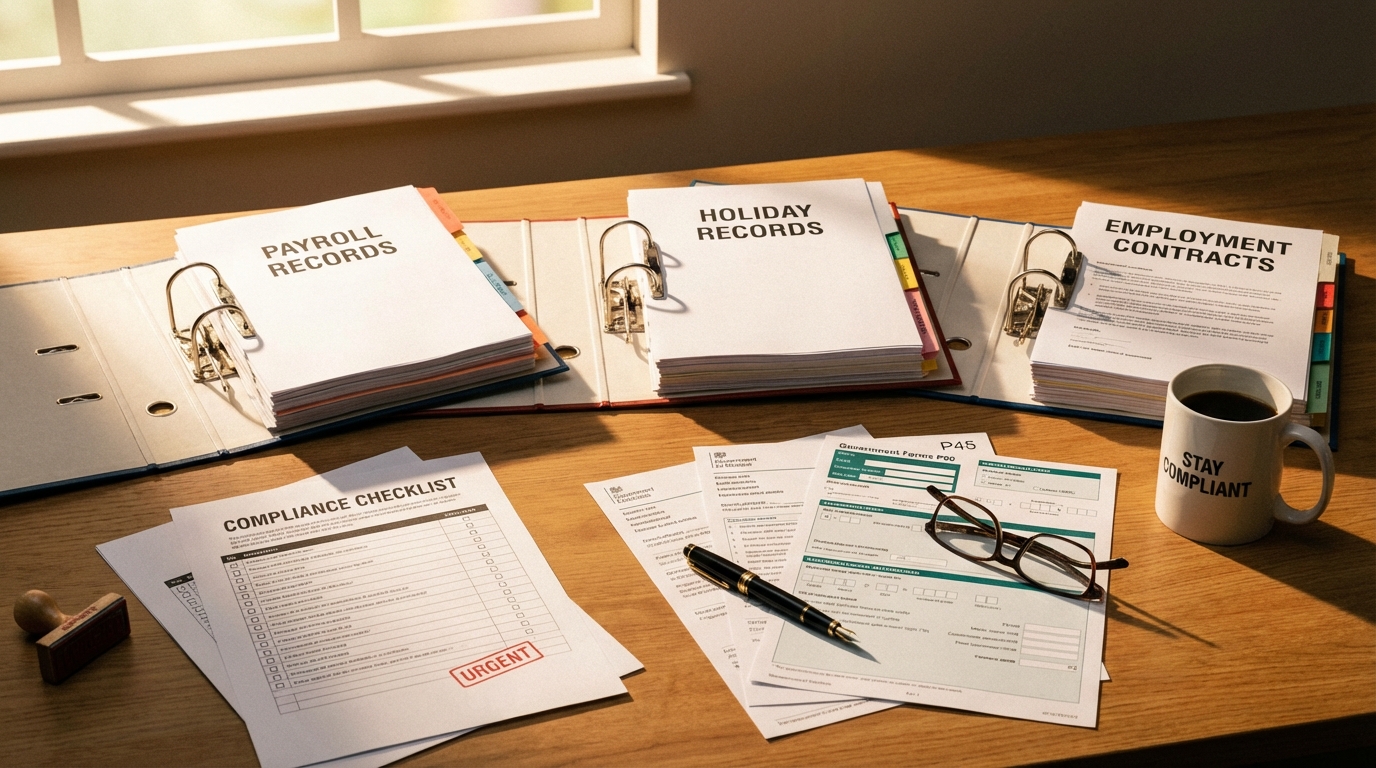
The Fair Work Agency opens for business at 7am tomorrow. No appointment. No complaint required. Inspectors can walk into any UK workplace and ask to see your records on the spot.
Most employers don't have them ready.
This is not a guide to what the FWA is — we covered that in our full launch explainer. This is the practical 90-minute checklist you can work through tonight to make sure you're not one of the businesses caught out in week one.
What the FWA Actually Checks on Day One
FWA inspectors arrive with a mandate to check National Minimum Wage compliance, statutory sick pay, holiday records, and — from today — zero-hours cancellation pay. They have six-year lookback powers. They don't need to receive a worker complaint to open an investigation.
Here are the 10 records they will ask for first.
The 10-Record Checklist
1. Payroll Records (6 Years)
What they check: That every worker — including casual, zero-hours, and agency — is paid at least £12.71/hour (NLW), £10.18 (18–20), £7.55 (16–17), £7.55 (apprentices in year one).
What to have ready:
- Payroll run records for at least the current and previous tax year
- Hourly rate breakdowns per worker (not just total pay)
- Records showing time worked vs. total paid (so the rate can be verified)
- Uniform costs, tip deductions, salary sacrifice — all must be excluded from the NLW calculation
The trap most employers miss: If you've been paying £12.21/hour, you're underpaying. The correct NLW rate from April 1, 2026 is £12.71. HMRC 200% penalty plus £20,000 per affected worker. Correct it tonight.
2. Time Records (Proving Hours Worked)
What they check: That you can demonstrate the hours each worker actually worked, to verify the effective hourly rate.
What to have ready:
- Clocking-in/out logs, rota records, or signed timesheets
- Records for salaried workers that show hours don't exceed 48/week (Working Time Regulations)
- Overtime records
The trap: "We pay them salary" is not a defence if the salary divided by hours works out below NLW. A salaried worker on £24,000/year working 50 hours/week earns below NLW. FWA will calculate it.
3. Zero-Hours Shift Schedules and Cancellation Records
What they check: Compliance with the new cancellation pay right (in force from today, enforced by FWA from 7am tomorrow).
What to have ready:
- Written record of shifts offered to each zero-hours/casual worker
- Record of shift cancellations and notice given
- Evidence that short-notice cancellations were compensated (new legal requirement as of April 7)
The trap: If you've been cancelling shifts by text at short notice and not compensating workers, the FWA can order back payment for every cancellation going back as far as the record allows. Start a cancellation log now.
4. Statutory Sick Pay Records
What they check: That SSP was paid correctly — and that the old "3-day wait" rule was not applied after April 6.
What to have ready:
- SSP payment records per worker
- Evidence that SSP was paid from day one of absence (for absences starting on or after April 6, 2026)
- Self-certification records for absences up to 7 days
The trap most employers are in: Your payroll system may still be set to the old 3-day wait. Check this tonight. An incorrect SSP deduction policy is now a criminal offence.
Also check: Your written sick leave policy. If it says "SSP applies from day 4", it's illegal. Print the policy, find the relevant line, correct it in writing tonight. Date the correction. This is your evidence of good faith.
5. Holiday Records (6 Years)
What they check: That annual leave was accrued, paid, and recorded correctly.
What to have ready:
- Annual leave accrual records per employee
- Records of leave taken (dates, days)
- Records of leave pay rates (must include regular overtime and commission in average holiday pay, not just basic rate)
- Records going back 6 years
The trap: Most HR software keeps 1-2 years of leave records. The FWA checks 6. If you can't produce them, you're exposed. Request archive exports from your HR system immediately.
6. Written Employment Contracts or Statements of Particulars
What they check: That every worker has a written Statement of Particulars — which is now required from day one of employment (not within two months as previously).
What to have ready:
- A signed Statement of Particulars for every worker (including part-time and casual)
- The statement must include: pay rate, hours, holiday entitlement, sick pay policy, notice period
- Day one workers engaged after April 6, 2025 must already have one
The trap: If you use casual workers on a "we'll get around to the paperwork" basis, the FWA will treat this as a missing document and escalate to an employment tribunal referral.
7. Right to Work Checks
What they check: That you have verified and documented the right to work in the UK for every employee.
What to have ready:
- Copy of verification document (passport, share code, UKVI result) for every worker
- Date the check was conducted
- Employer signature confirming check
The trap: FWA inspectors work alongside Home Office teams. An NMW investigation can immediately become an illegal working investigation if right to work documents are missing.
8. Workers Classified as Zero-Hours (vs. Employees)
What they check: Whether workers you classify as "self-employed" or "zero-hours" actually meet the legal definition of that classification.
What to have ready:
- Contracts for any self-employed or gig workers
- Evidence of genuinely flexible/self-directed working (not just a relabelled employment relationship)
- Evidence that zero-hours workers have not been blocked from taking other work
The trap: Misclassification is one of the FWA's top priorities. A "self-employed" kitchen porter who works 35 hours/week for one employer, can't work elsewhere, and uses your equipment is probably an employee. Treat them as one — tonight if necessary.
9. Agency Worker Records (If Applicable)
What they check: That agency workers are being paid the correct rate once they've passed the 12-week qualification period.
What to have ready:
- Agency agreement stating pay rates
- Start dates for each agency worker
- Evidence that after 12 weeks, their rate meets the comparator employee's rate
The trap: Agencies manage compliance, but you're jointly liable. If the agency has been underpaying workers placed at your site, you share the liability.
10. Bereaved Partner's Paternity Leave Records
What they check: This new right came into force on April 6, 2026 — the right to 52 weeks' leave (2 paid) for partners of parents who die during or shortly after childbirth.
What to have ready:
- Evidence you know this right exists (training record or policy update is sufficient for now)
- A draft policy or notice to managers
- HR briefing notes
The trap: This right has near-zero employer awareness. FWA inspectors expect you to demonstrate knowledge, even if no case has arisen. If a relevant situation does arise and you have no policy, the FWA can refer to employment tribunal.
What Happens If You Can't Produce Records
If an FWA inspector arrives and you can't produce records on the spot, they will:
- Serve a formal notice requiring production within 14 days
- Flag the business for follow-up inspection
- Issue an immediate enforcement notice if SSP or NMW records are missing
- Calculate underpayment estimates based on available evidence — and you must disprove them
For NMW: HMRC is notified automatically. A 200% penalty on underpayment plus up to £20,000 per worker. Named in public enforcement lists.
For SSP: Criminal prosecution risk. Unlimited fine. The Crown Prosecution Service treats deliberate SSP underpayment as wage theft.
How ComplianceAlert Supports Your Ongoing Compliance
The Fair Work Agency is not a one-time event. FWA inspectors will return to businesses that were found non-compliant in week one. They will publish enforcement reports. They will share findings with HMRC.
ComplianceAlert monitors FWA enforcement guidance, NMW rates, SSP updates, and holiday pay case law — and sends you plain-English alerts when the rules change. You'll know about rate changes, new rights, and enforcement shifts before they reach your payroll.
Not sure if your records are in order?
Take our free Compliance Score quiz — 20 questions, instant results. See exactly where your business stands before an FWA inspector does.
Your 90-Minute Action Plan for Tonight
Work through this before 7am tomorrow:
- Check your NLW rate — Is everyone on at least £12.71? Fix it in payroll now.
- Export 6 years of holiday records — Request archive data from your HR system.
- Check your SSP policy — Find the document, remove the 3-day wait clause, date the correction.
- Audit contracts — Do all workers (including casual) have a Statement of Particulars?
- Create a cancellation log — For zero-hours workers, start recording shift cancellations and notice given from today.
- Pull right-to-work documents — Make sure copies are on file for every current worker.
You don't need to be perfect. You need to demonstrate good faith and active compliance. Inspectors are instructed to be proportionate with businesses that can show they're trying.
Key Takeaways
- The FWA opens at 7am Tuesday with full enforcement powers — no complaint needed
- The 10 records above are what they will ask for first
- NLW £12.71 (not £12.21) — correct tonight if you're on the wrong rate
- SSP from day one is now law — your written policy must reflect this
- Zero-hours cancellation pay is a new right from today — start recording cancellations
- Six-year lookback means historic records matter, not just current ones
Start your free 7-day trial of ComplianceAlert to get real-time alerts as FWA enforcement guidance is published: compliancealert.co.uk — no credit card required.
Keep regulatory updates in one place
Read regulatory alerts and use a checklist for your sector in the free ComplianceAlert dashboard.
Create your free account →No card needed · Email confirmation required · Email alerts are on paid plans
Have a question?
Ask us about getting started with ComplianceAlert.
Call Alice: +44 23 9433 0468 (network charges may apply) · hello@compliancealert.co.uk


